- Home
- About Us
- Products
- News
- Blog
- Contact Us
Inquiry
Form loading...
Choosing among the 2026 Top Aluminum Heatsink Extrusion Manufacturers requires more than comparing product catalogs. Thermal performance depends on alloy selection, profile geometry, machining accuracy, surface treatment, and production consistency. A polished website proves little.
The International Aluminium Institute continues to document aluminum’s importance in modern manufacturing and its growing recycling potential. European Aluminium reports that recycled aluminum can require up to 95% less energy than primary production. These figures matter for data centers, electric vehicles, LED lighting, and industrial power electronics. Aluminum alloy 6063 remains widely used because it combines good thermal conductivity, clean extrusion surfaces, and reliable machinability. However, alloy choice should follow the application, not habit.
Avram Bar-Cohen, a recognized thermal-management researcher, has often stated, “The future of electronics is thermal.” That warning explains why Aluminum Heatsink Extrusion deserves careful supplier evaluation. Buyers should examine thermal-resistance testing, extrusion tolerances, billet quality, anodizing thickness, cooling-fin uniformity, and documented production capacity. Reports from MarketsandMarkets and Grand View Research also indicate sustained growth across thermal-management and aluminum-extrusion markets, driven by higher power density and electrification.
A ranking can still mislead. Some manufacturers publish impressive capacity but limited test evidence. Others deliver excellent profiles yet struggle with complex machining or smaller orders. This guide therefore compares technical capability, quality systems, customization experience, lead times, sustainability practices, and customer support. The evidence is not always perfect. Supplier claims require verification. That is the uncomfortable part.
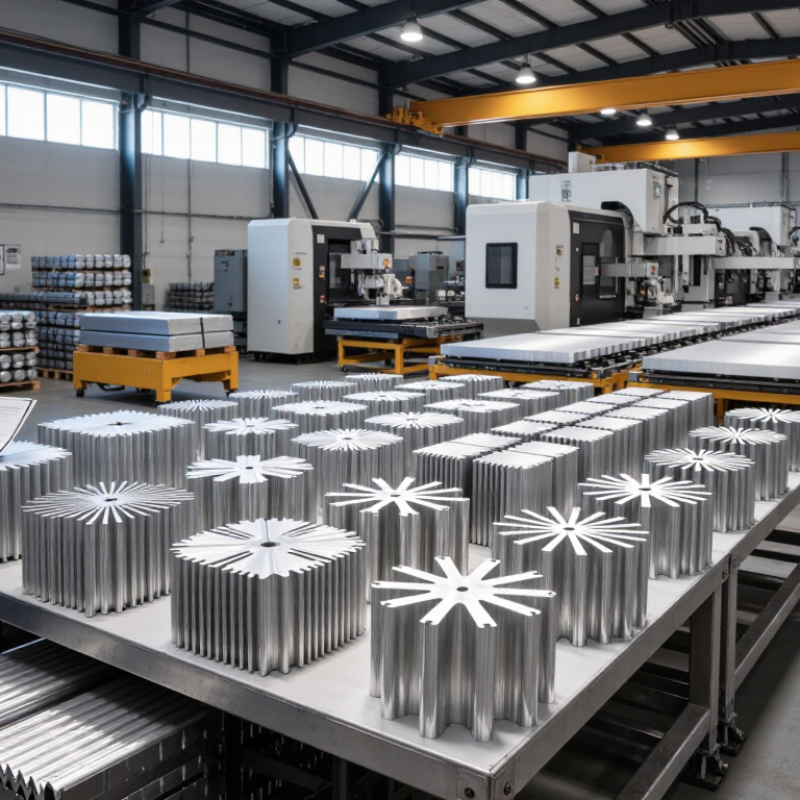
2026 Top Aluminum Heatsink Extrusion Manufacturers?
What Defines a Leading Aluminum Heatsink Extrusion Manufacturer in 2026?
A leading manufacturer begins with thermal evidence, not attractive product photos. Its engineers select aluminum alloys according to conductivity, strength, corrosion resistance, and operating temperature. They refine die geometry for thin fins, clean channels, and stable wall thickness. Small differences matter. A fin variation of 0.2 millimeters can affect airflow and assembly fit.
Practical experience appears in the factory details. Skilled teams monitor billet temperature, extrusion speed, quenching, and aging conditions. They inspect profiles with coordinate measuring equipment and verify thermal performance through controlled testing. Reliable suppliers should provide material certificates, dimensional reports, surface-finish records, and batch traceability. Clear documents build trust. Vague promises do not.
Customization also defines expertise in 2026. A capable partner can review fan clearance, mounting holes, interface flatness, and machining requirements before production. It should explain trade-offs honestly, including pressure drop, weight, tooling cost, and delivery risk. I have seen designs become expensive because fin density was increased without checking airflow. That mistake is easy to repeat.
No factory gets everything perfect. Delayed feedback, inconsistent packaging, or unclear revision control can still disrupt a strong project. The better manufacturer admits these weaknesses and corrects them with measurable actions. Energy use, recycled content, worker safety, and responsible sourcing also deserve attention. Technical excellence now includes what happens beyond the extrusion press.
| Evaluation Dimension | Reference Data or Benchmark | Why It Matters in 2026 | Recommended Verification Evidence |
|---|---|---|---|
| Primary Heat-Sink Alloy | 6063 aluminum alloy is widely selected for extruded heat sinks because it offers good extrudability, surface finish, corrosion resistance, and thermal performance. | Suitable for complex fin profiles and high-volume production while maintaining consistent dimensional quality. | Material certificate identifying alloy chemistry and applicable standard, such as ASTM B221 or EN 755. |
| Higher-Strength Alloy Option | 6061-T6 aluminum provides higher mechanical strength than 6063 alloys, with typical thermal conductivity lower than 6063-T5 or 6063-T6. | Useful where the heat sink must also provide structural support, mounting strength, or improved resistance to mechanical loading. | Alloy and temper certificate, tensile-strength report, and hardness test results. |
| Thermal Conductivity | Typical nominal values are approximately 201 W/m·K for 6063 aluminum and approximately 167 W/m·K for 6061 aluminum; actual values vary with temper and specification. | Higher conductivity can reduce thermal spreading resistance, but final performance also depends on fin geometry, contact area, airflow, and surface treatment. | Published alloy datasheet and, where required, thermal testing under defined laboratory conditions. |
| Extrusion Profile Capability | A leading supplier should demonstrate stable production of thin fins, narrow channels, deep profiles, and hollow or semi-hollow sections within agreed design limits. | Complex profiles can increase surface area and reduce system size, but they require controlled die design and extrusion parameters. | Tooling drawings, profile inspection reports, first-article approval, and production capability samples. |
| Dimensional Control | Profile tolerances should be agreed using the applicable extrusion standard, such as EN 755-9 or ASTM B221, rather than using a generic tolerance claim. | Accurate dimensions support reliable assembly, flatness, mounting pressure, and repeatable thermal interface performance. | Inspection plan showing critical dimensions, flatness, straightness, twist, and measurement equipment calibration. |
| Surface Flatness | The required base flatness depends on the thermal interface material, fastening method, and application heat load; the value should be specified on the engineering drawing. | Improved contact between the heat sink and heat source helps reduce interface thermal resistance. | Coordinate-measuring-machine report, surface plate inspection, or documented flatness measurement method. |
| Surface Finishing | Common options include mill finish, anodizing, powder coating, and chemical conversion coating. Anodizing can improve corrosion resistance and provide electrical insulation, but it may affect interface areas. | Finish selection must balance corrosion protection, appearance, emissivity, electrical requirements, and thermal contact performance. | Coating specification, color or thickness tolerance, adhesion test, corrosion test, and masking requirements. |
| Thermal Performance Testing | Thermal resistance is application-specific and should be reported in °C/W or K/W under defined power, airflow, orientation, interface material, and mounting conditions. | A credible manufacturer does not present a single thermal-resistance number without test conditions. | Thermal test report including heat source, ambient temperature, airflow rate, thermocouple locations, and stabilization criteria. |
| Design and Simulation Support | Preferred suppliers can review fin spacing, base thickness, extrusion direction, pressure drop, airflow, and manufacturability before tooling begins. | Early design validation reduces die changes, production scrap, pressure-drop problems, and thermal-performance risk. | DFM review, thermal simulation assumptions, prototype comparison, and documented design-change process. |
| Tooling and Die Management | Reliable production requires controlled die design, die maintenance, trial records, and documented approval of replacement or modified tooling. | Die condition strongly affects fin consistency, surface quality, dimensional stability, and production yield. | Tooling records, die-life history, maintenance schedule, trial-extrusion report, and spare-die plan. |
| Quality Management | ISO 9001 certification is a useful baseline for documented quality processes, corrective action, traceability, and continual improvement. | Consistent process control is essential when heat sinks are supplied for electronics, automotive, energy, or industrial equipment. | Valid certificate issued by an accredited certification body, process-control plan, and nonconformance records. |
| Material Traceability | Each production lot should be traceable to the aluminum billet, alloy, temper, extrusion date, surface treatment, and inspection records. | Traceability supports field investigation, regulatory documentation, and repeat-order consistency. | Lot numbers, mill certificates, production travelers, inspection records, and shipment documentation. |
| Regulatory Compliance | For applicable markets, suppliers should support requirements related to RoHS, REACH, conflict minerals reporting, and customer-specific restricted-substance lists. | Compliance documentation helps reduce market-access delays and supply-chain reporting risk. | Declaration of conformity, restricted-substance statement, supplier declarations, and updated compliance records. |
| Production Scalability | Capability should be evaluated across prototype, pilot, and mass-production stages rather than by equipment count alone. | Demand for power electronics, LED systems, battery systems, data infrastructure, and industrial controls requires stable capacity transitions. | Capacity plan, lead-time history, production scheduling method, yield data, and contingency plan. |
| Sustainability Performance | Aluminum is highly recyclable, and recycled content can be specified when alloy chemistry, quality, and supply-chain controls are maintained. | Lower-carbon material sourcing and documented recycling practices are increasingly important in product lifecycle reporting. | Recycled-content declaration, environmental data, energy-management records, scrap-recovery process, and supplier sustainability audit. |
| Packaging and Logistics | Packaging should prevent fin deformation, scratching, contamination, moisture damage, and mixed-lot identification errors. | Heat sinks often contain delicate fins that can be damaged after production even when extrusion quality is acceptable. | Packaging specification, drop or vibration test where applicable, palletization plan, labeling standard, and delivery-performance data. |
| Customer-Service Responsiveness | A strong supplier provides clear engineering communication, drawing review, sample feedback, corrective-action response, and change notification. | Fast technical coordination reduces development time and helps prevent uncontrolled changes in production. | Documented communication workflow, response-time target, engineering-contact structure, and corrective-action records. |