- Home
- About Us
- Products
- News
- Blog
- Contact Us
Inquiry
Form loading...
Choosing among the Top 10 Aluminum Heatsink Extrusion Manufacturers requires more than comparing catalog prices. A credible review must examine alloy selection, extrusion tolerances, thermal performance, surface finishing, tooling capability, and production consistency. Profiles may look similar on paper, yet a small change in fin spacing can affect airflow, pressure drop, and operating temperature. That detail matters.
Dr. Yogendra Joshi, a recognized thermal-management researcher, explains, “Thermal design is a system problem, not merely a materials problem.” This principle guides our evaluation of the Aluminum Heatsink Extrusion industry. A manufacturer should understand the complete cooling assembly, including the heat source, interface material, fan direction, mounting pressure, and surrounding enclosure. Experience also appears in practical details. Can the supplier produce a 0.8-millimeter fin without distortion? Can it maintain flatness after anodizing? Can it provide test data instead of broad performance claims?
Evidence matters.
This introduction presents ten manufacturers through an engineering-focused lens. It considers factory experience, quality controls, customization, lead times, tooling support, and documented customer applications. Certifications can strengthen confidence, but they do not replace measurable results. Some rankings may remain imperfect because manufacturers disclose different levels of information. That limitation deserves attention. Buyers should verify thermal testing, alloy certificates, dimensional reports, and production samples before making a final decision. The strongest supplier is not always the largest one. It is often the partner that understands the application, communicates clearly, and delivers repeatable Aluminum Heatsink Extrusion components under real operating conditions.
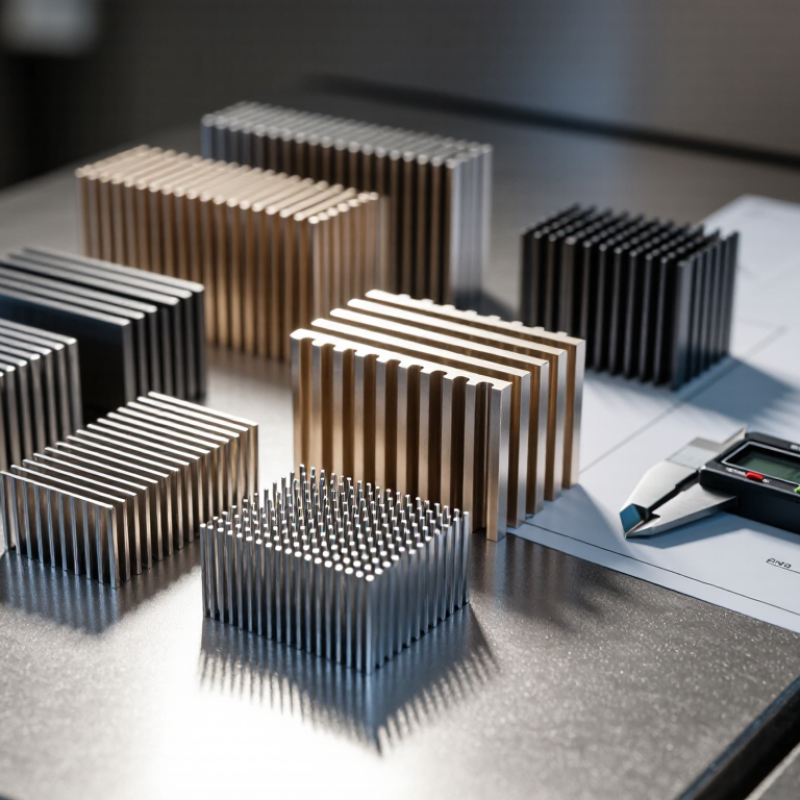
An aluminum heatsink extrusion manufacturer designs and produces metal profiles that move heat away from electronic components. It turns aluminum billets into long, shaped sections through controlled pressure and heat. The process begins with thermal design, not with the extrusion press. Engineers study wattage, airflow, mounting space, and the required operating temperature.
They calculate fin height, wall thickness, and spacing before creating the extrusion die. The profile then passes through a heated die at steady speed. Simple? Not always. Small changes in speed can affect surface quality and dimensional accuracy. After extrusion, workers cut the material to length and may add drilling, tapping, milling, or protective finishing. These details matter during final assembly.
A reliable manufacturer also manages inspection and documentation. Inspectors check dimensions, alloy condition, flatness, burrs, and mounting surfaces. Thermal testing can reveal whether a profile performs as predicted under real airflow. Traceable material records and clear tolerance reports support professional purchasing decisions. Experience helps, but it does not remove every risk. A fin may look excellent while showing poor contact with a processor. For buyers comparing the top ten manufacturers, asking for samples, test data, production photos, and quality records is practical. That evidence is stronger than attractive claims.
An aluminum heatsink extrusion manufacturer produces thermal-management profiles by forcing heated aluminum billets through a shaped die. The resulting profiles are commonly cut, machined, finished, and assembled for LED lighting, power electronics, telecommunications, industrial controls, and other heat-dissipation applications.
The comparison below uses anonymous manufacturer profiles rather than company names or brands. The capability ranges reflect commonly used industry specifications for aluminum heatsink extrusion suppliers.
| Rank | Anonymous Manufacturer Profile | Primary Market Coverage | Common Heatsink Alloys | Typical Extrusion Tolerance | Profile Complexity | Finishing Options | Common Standards | Typical Applications |
|---|---|---|---|---|---|---|---|---|
| 1 | Profile A — High-Volume Integrated Producer | Global OEM supply | 6063, 6060, 6061 | Approximately ±0.10–0.30 mm, depending on section size | Deep fins, thin walls, multi-void profiles | Anodizing, powder coating, chemical conversion | ASTM B221, EN 755, ISO 9001 | Industrial power supplies, telecom equipment, LED systems |
| 2 | Profile B — Precision Thermal-Management Specialist | Electronics and energy systems | 6063-T5, 6063-T6, 6061-T6 | Approximately ±0.10–0.20 mm for controlled sections | High fin-density and narrow thermal channels | Clear or black anodizing, CNC machining | ASTM B221, EN 12020, RoHS-compatible production | Power semiconductors, battery systems, motor drives |
| 3 | Profile C — Large-Section Extrusion Supplier | Industrial and infrastructure projects | 6063, 6061, 6005A | Approximately ±0.20–0.50 mm | Large base plates, wide fins, structural heat spreaders | Anodizing, powder coating, mill finish | ASTM B221, EN 755, ISO 14001 practices | Industrial inverters, automation cabinets, HVAC equipment |
| 4 | Profile D — Custom Low-to-Medium Volume Producer | Prototype and specialized equipment | 6063-T5, 6061-T6 | Approximately ±0.15–0.40 mm | Customized fins, mounting channels, integrated fastener tracks | Cutting, drilling, tapping, anodizing | ASTM B221, ISO 9001, RoHS requirements | Test equipment, robotics, medical electronics |
| 5 | Profile E — Automotive and Mobility Supplier | Automotive and transportation | 6061-T6, 6063-T6, 6005A | Approximately ±0.15–0.35 mm | Long profiles, cooling channels, lightweight structural sections | Saw cutting, CNC machining, surface treatment | IATF 16949, ASTM B221, EN 755 | Battery packs, onboard chargers, electric motor systems |
| 6 | Profile F — LED and Lighting Extrusion Supplier | Commercial and architectural lighting | 6063-T5, 6060-T5 | Approximately ±0.10–0.30 mm | Slim fins, diffuser channels, recessed mounting features | Anodizing, powder coating, polishing | EN 755, EN 12020, RoHS requirements | LED luminaires, strip-light channels, display lighting |
| 7 | Profile G — Export-Focused Contract Manufacturer | International private-label production | 6063, 6061, 6005A | Approximately ±0.20–0.50 mm | Standard and semi-custom heatsink sections | Anodizing, powder coating, CNC secondary operations | ASTM B221, EN 755, ISO 9001 | Consumer electronics, control panels, networking hardware |
| 8 | Profile H — High-Conductivity Electronics Supplier | Power conversion and communications | 6063-T5, 6061-T6 | Approximately ±0.10–0.25 mm | High surface-area fins and thermal interface bases | Flatness correction, machining, anodizing | ASTM B221, EN 12020, RoHS requirements | Rectifiers, telecom amplifiers, server power modules |
| 9 | Profile I — Integrated Fabrication and Assembly Supplier | OEM and system integrator projects | 6063-T5, 6061-T6, 6005A | Approximately ±0.15–0.40 mm | Extruded bases with machined holes and attachment features | Machining, deburring, anodizing, assembly | ISO 9001, ASTM B221, EN 755 | Industrial computers, chargers, instrumentation |
| 10 | Profile J — Standard Catalog and Rapid-Delivery Supplier | Maintenance, distribution, and general industry | 6063-T5, 6061-T6 | Approximately ±0.20–0.50 mm | Standard fin arrays and cut-to-length profiles | Mill finish, anodizing, basic machining | ASTM B221, EN 755, RoHS requirements | Enclosures, test fixtures, small electronic devices |